

The JV InvenTeams Pump it Up activity guide will lead educators and students through the creative applications of human energy and power and explore topics such as:
- Design Process
- Human Energy and Human Power
- Hydraulics
- Pumps
- Uses of Pumps
Download the list of materials and tools used in this guide.
Description
Grade level: 6-10
Summary of lesson:
Students will design and build a water pump operated by human energy. Students will learn about renewable and non-renewable sources of energy and begin to think about the potential of human energy to power a device. Students will begin to think about possible uses for a water pump powered by human energy that they will construct after calculating the force, work, and power the human body can generate. Students will work in teams to choose a use for their pump and sketch a prototype of it.
Time/Duration:
Each unit is designed to be 90 minutes. Teachers break down the lesson based on schedule minutes and available time. Example: 7th-8th grade science teaches 1 unit a week, and he meets 3 days a week, once for 55 minutes and twice for 90 minutes. It depends on deep educators who want to take it.
Topics Covered:
-Design Process
-Human Energy and Human Power
-Hydraulics
-Pumps
-Uses of Pumps
Subject areas/Standards:
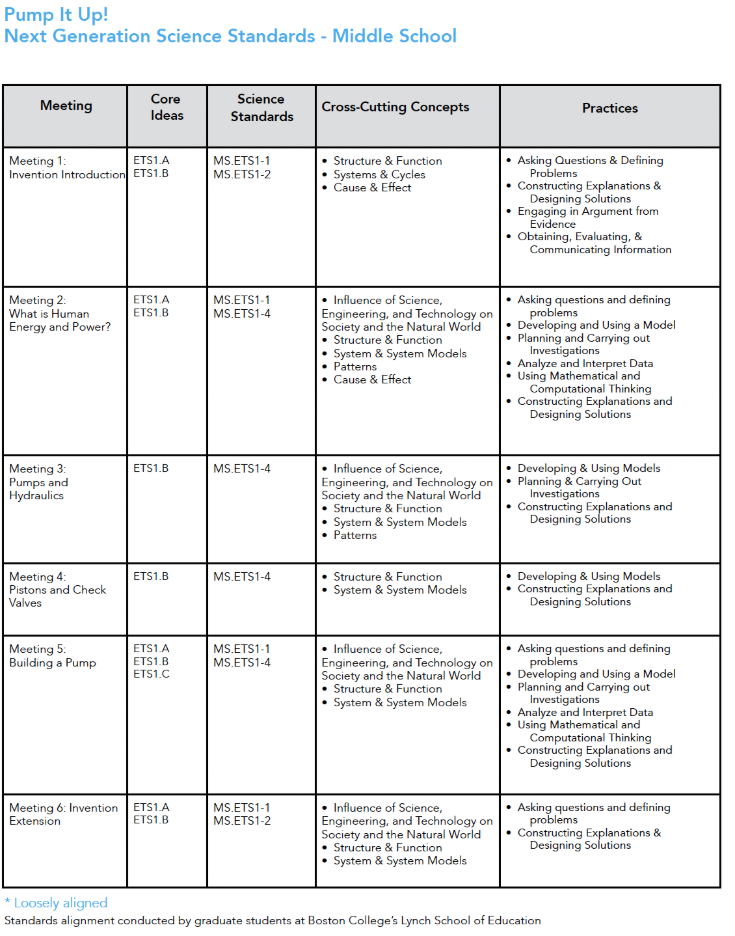
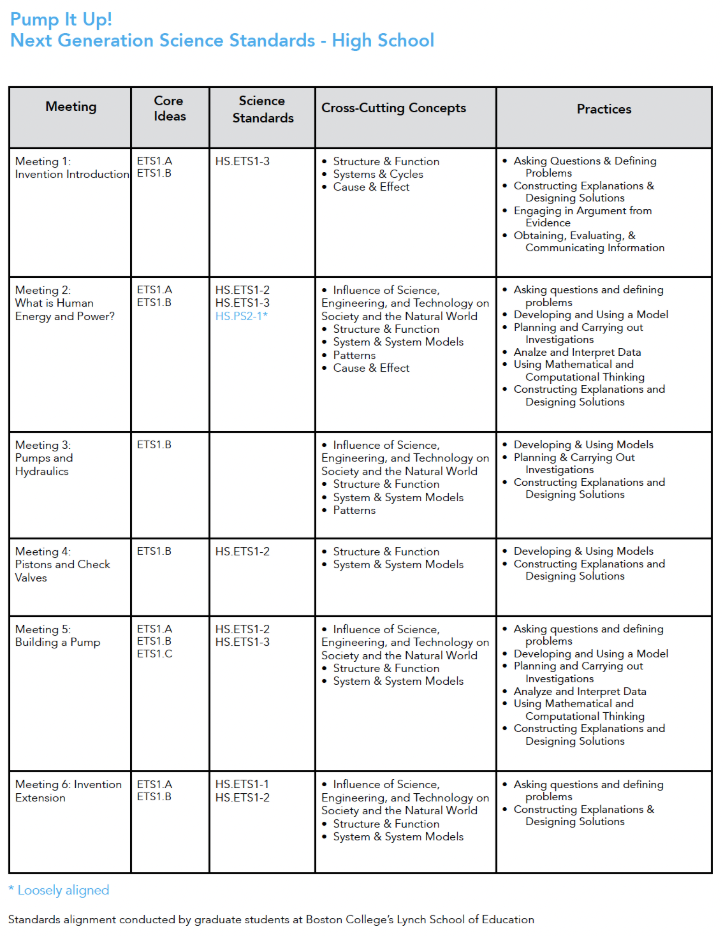
Breakdown of lessons:
1. Invention Introduction
Students do warm-up activities and discuss invention. Students play “Four Corners” to help the educator assign diverse teams.
2. What Is Human Energy and Power?
Students learn about the different types of energy and, specifically, how human energy can be harnessed to accomplish many different goals. They also learn the physics and mathematics behind calculating power, work, and force. The educator introduces the main design challenge of the unit and students begin to think about possible uses for their water pumps powered by human energy.
3. Pumps and Hydraulics
Students learn about different types of pumps and their potential uses. They build and test a simple Archimedes screw pump and a prototype of a hydraulic pump. Students also continue discussing potential uses for their water pumps.
4. Pistons and Check Valves
Students take apart a bicycle pump to see firsthand how it operates, and then begin to build their own water pumps. They practice cutting PVC as they learn to build check valves.
5. Building a Pump
Students assemble their water pumps, test them, and re-sketch a design to customize their water pumps for a particular use.
6. Invention Extension
Students conceptualize a purposeful invention that uses their new minds-on and hands-on skills from the Pump It Up! unit.
Download the list of materials and tools used in this guide.


