

Grade level: 4-5
This transdisciplinary unit guides upper elementary students as they develop skills in inventive thinking and basic circuitry/shoe design through fun, hands-on activities. During this 16-meeting guide (approximately 45 minutes per meeting), students will gain an understanding of shoe design, drawing on inspiration from around the world, and basic circuitry to light up their very own shoes.
Description
Summary of lesson:
This transdisciplinary unit guides upper elementary students as they develop skills in inventive thinking and basic circuitry/shoe design through fun, hands-on activities. During this 16-meeting guide (approximately 45 minutes per meeting), students will gain an understanding of shoe design, drawing on inspiration from around the world, and basic circuitry to light up their very own shoes.
Lessons will help students find inspiration for their designs through their exploration of nature (such as animal hooves/paws), indigenous or culture-specific textile designs, and shoe-related inventors from different cultural backgrounds. Cross curricular connections among subject areas are highlighted as students learn about the history of shoes, learn about shoes from around the world, explore the artistry of designing footwear, and write about their prototypes for a culminating presentation.
Students will see connections between STEM and their own lived experiences, thus increasing their engagement and persistence in the innovation ecosystem.
Time/Duration: designed to be 16 meetings, 45 mins each meeting
Learning Outcomes:
- Understanding the invention design process; building a prototype; basic circuitry (building a simple circuit), biomimicry, and sustainable design.
- Sketching, working with clay, and building a 3D object with various materials
- Learning about the history of footwear in various countries; making connections between their own cultural/ethnic backgrounds in relation to footwear and textiles.
- Learning new vocabulary words specific to invention; reading texts and answering questions via written summaries/making inferences; conducting research; oral presentation skills
Subject areas/Standards:
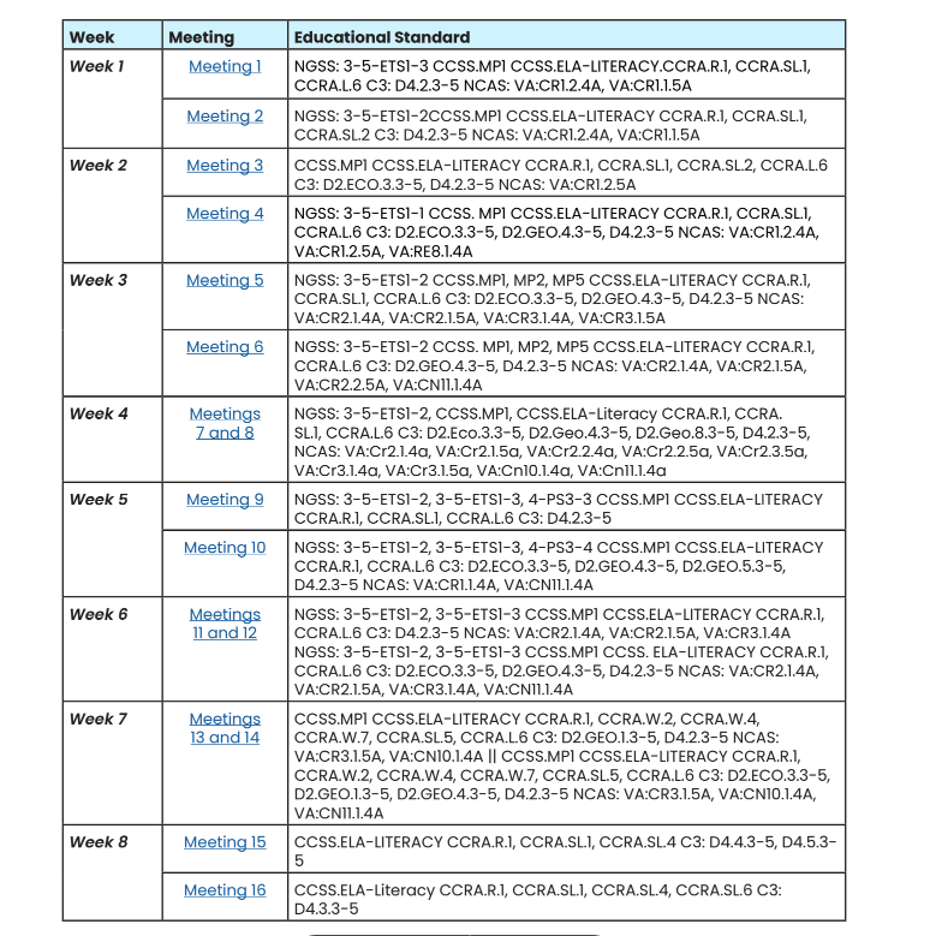
Breakdown of Lessons:
Week 1: Invention Introduction
Meeting 1 -What is Invention? Learn about invention and the invention process. Read about historical inventors and their inventions. Have fun with a warm-up invention activity.
Meeting 2 – More About Invention. You will participate in a fun, hands-on invention activity where you pick a problem from a hat to solve. Next, you will watch short videos from an old PBS show where girls invent their own shoes.
Week 2: Introduction to Shoe Design
Meeting 3 – All About Shoes. In this meeting you will be introduced to footwear and gain a brief history of shoes from around the world. You will also be introduced to biomimicry which is seeing animals and nature as inspiration for design. The meeting will culminate in an introduction to the shoe you will invent in this program.
Meeting 4 – Exploring Shoes. Today you will dive deeper into all things footwear by observing your own shoes, understanding the different components of a shoe, and reading about the cultural importance of shoes. At the end, you will choose an activity or sport for the shoe you will invent. Your homework will be figuring out the country your shoe will reflect – ideally interviewing family members to get a better feel for your background!
Week 3: Building Shoe Outsoles
Meeting 5 - Shoe Sketch: You will meet in pairs to share your research, followed by learning how to draw to scale. Most of the meeting will be spent brainstorming your outsole design and creating sketches. You will look to nature for inspiration and include design elements from your country of choice.
Meeting 6 – Create Shoe Soles: You will work individually to create your own shoe outsole using foam clay and clay tools. Use your drawings to guide your work. Insert a thin cardboard border into the top of the outsole, which will serve as the connecting point for building your upper shoes in the next meetings. Begin reading about shoes from around the globe, starting with Serbia!
Week 4: Building Uppers (2 meetings)
Meetings 7 and 8 - Build Upper Shoes: You will use these two meetings to build the upper part of your shoe prototypes. Use your sketches from the previous meetings to inform your work. You will use materials such as wire, cardboard, feathers, sponges, and culturally relevant fabrics. You will pair up with your partner to get feedback before completion. Read about shoes in Uganda.
Week 5: Basic Circuitry
Meeting 9 - Circuitry Background: By now you should have a successful shoe prototype! The next step will be adding an element of fun to your shoe by lighting it up. To accomplish this, you will first learn some basics about batteries and circuits, the foundation of electricity. You will create your own circuit to light up a bulb. Then you will get to experiment with materials to see if they are conductors or insulators.
Meeting 10 - Paper Circuits: Today you will use your knowledge of basic circuitry to create a light-up paper circuit. This will help you determine the placement for your light(s) in your shoe prototype in the meetings to come. Read about shoes in Taiwan.
Week 6: Light Up the Shoes (2 meetings)
Meetings 11 and 12 – Light Up Your Shoe: In the next two meetings you will have the chance to light up your shoe prototype. As you recall, inventor Nicholas Rodgers was the first to do this in the late 1980s for safety reasons – so his daughter could safely play outdoors during dark, winter days. You will be using the same materials as last time (coin cell battery, copper tape, LEDs) to accomplish this. You will also use this week to make any redesigns on your shoe. Read about shoes in Tunisia.
Week 7: Presentation Prep (2 meetings)
Meetings 13 and 14 – Poster Design: In the next two meetings you will spend time designing a trifold poster to present your shoe prototype. This may involve some additional research on your country. Read about shoes in Brazil.
Week 8: Showcase Week
Meeting 15 – Practice Presentation: Today you will practice your poster presentation and prepare for the upcoming showcase. You will begin to think about how you can apply your new building and circuitry skills to other inventions. What problems can you solve?
Meeting 16 – Showcase Day: Today is the big day of the showcase! Have fun presenting your prototype/poster and learning about different cultures around the world. At the end of the showcase, you will receive a certificate from your teacher, celebrating your amazing efforts.
Materials:
Amazon list: https://a.co/09DnVvKz
- Recyclables to collect ahead of time: folded thin cardboard (i.e., cereal boxes), egg cartons, packaging materials, newspaper, fabric or clothing scraps, old shoes, paper towel and toilet paper tubes, leftover crafting supplies
- Paper plates (pack of 100)
- Paper cups (pack of 50 twelve-oz cups)
- Plastic utensils (48-piece set)
- Aluminum foil (1 roll, 250 sq ft)
- Duct tape (3-pack)
- Masking tape (3-pack)
- Wrapped treats or toys (1 per student)
- Paper clips (pack of 200)
- Small all-metal binder clips (40-pack, ¾ in width)
- Index cards (100-pack)
- Rubber bands (100-pack)
- Foam clay, air dry (5 one-pound bags)
- Clay carving tools (3 sets)
- Chicken wire rolls (2 rolls of 10 ft)
- Brillo pads or sponges (1 per student)
- Feathers (bag of assorted colors)
- Felt pieces (assorted colors, 8x12 inch)
- Foam craft sheets (pack of 30)
- Wire cutters/strippers (4)
- Hot glue guns and glue sticks (4)
- Christmas tree lights (1 light per team of 3-4 students)
- D cell batteries (1 per team of 3-4 students)
- Roll of pennies (1)
- ¼ in copper tape (4 rolls)
- Coin cell lithium 20 mm batteries (2 per student)
- 5 mm LEDs assorted lights (1 box)
- Hole puncher (2-pack)
- Construction paper, assorted colors (200 sheets)
- Trifold posterboards (1 per student, 48 in x 36 in)
- Chalk (1 pack)
- Washable markers (4 packs)
- Colored pencils (4 packs)
Multi-cultural fabric samples with different patterns


