

The JV InvenTeams Green Chemistry activity guide, developed in collaboration with Beyond Benign, will lead educators and students through the creative applications of green chemistry and explore topics such as:
- Sustainability
- Bioplastics
- Chemical Science
Download the list of materials and tools used in this guide.
Description
Grade level: 6-10
Summary of lesson:
Students will develop sustainable bioplastic prototypes made from benign materials in this Green Chemistry unit. They will learn about the life cycle of conventional petroleum-based plastics and consider how each stage of the life cycle could be improved upon to make the process more sustainable. Students will learn about the role that Green Chemistry plays in intentionally designing chemical products that are safer for humans and the environment. During their various trials, students will experimentally determine the role that the concentration and pH of a solution play in breaking down a starch into polymers and monomers. They will also learn how the type and size of starch granules influence the flexibility of your bioplastic. Students employ these chemistry principles to optimize their bioplastic formulation to create alternatives to plastics currently in use. They will consider improvements on the design as part of the prototyping process.
Time/Duration:
Each unit is designed to be 90 minutes. Teachers break down the lesson based on schedule minutes and available time. Example: 7th-8th grade science teaches 1 unit a week, and he meets 3 days a week, once for 55 minutes and twice for 90 minutes. It depends on deep educators who want to take it.
Learning Principles by Subject Area:
-Green Chemistry
-Chemical reactions
-Laboratory safety
-Prototyping
Subject areas/Standards:
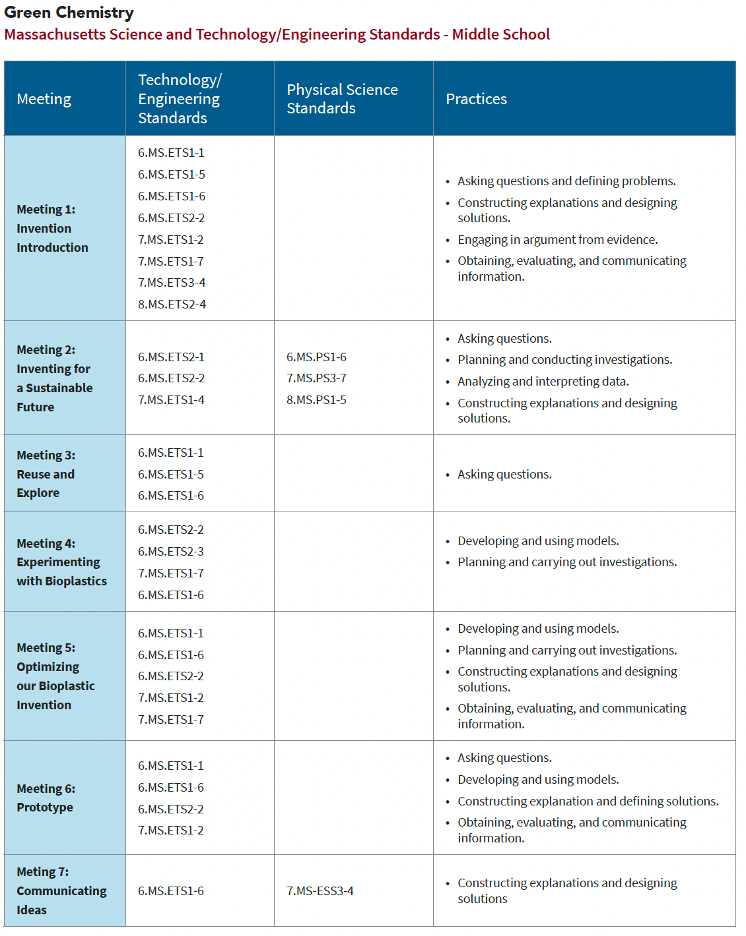
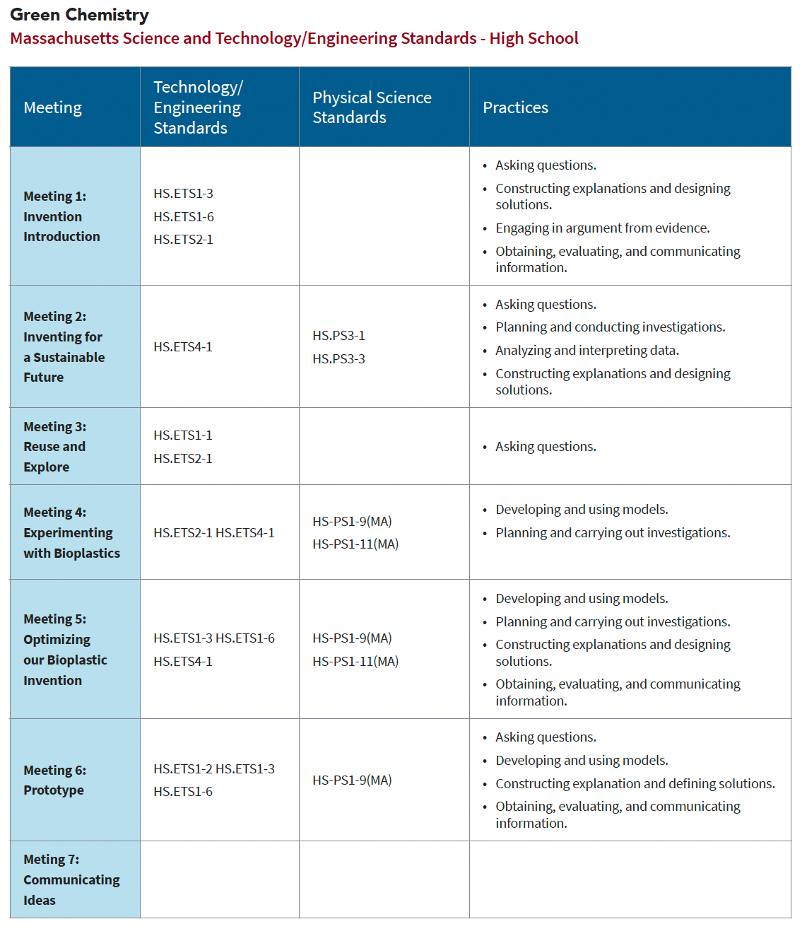
Breakdown of lessons:
1. Invention Introduction
Students do warm-up activities and discuss invention. Students play “Four Corners” to help the educator assign diverse teams.
2. Inventing for a Sustainable Future
Students learn about laboratory safety, inventing, and Green Chemistry. Students create benign lava lamps that use nontoxic materials that easily decompose.
3. Reuse and Explore
Students demonstrate an understanding of how plastics are produced when a starch is heated in the presence of an acid. Students reuse, experiment, and test the components of their benign lava lamp to examine the properties of a bioplastic in different environments.
4. Experimenting with Bioplastics
Students will comply with laboratory safety procedures to create bioplastics, compare their properties, and identify properties needed for their unique bioplastic prototype.
5. Optimizing Our Bioplastic Invention
Students will examine the role that concentration and pH of the solution play in the properties of a bioplastic. Students use their knowledge of bioplastic properties to brainstorm ideas for a prototype.
6. Prototype
Students optimize the bioplastic-making process to create a unique bioplastic with specific properties needed to create their prototype. Students will then write a pitch to communicate about their invention.
7. Communicating Ideas
Students communicate a purposeful invention that uses their new minds-on and hands-on skills from Green Chemistry.
Materials: Link to List


